
40 Random Facts Nobody Asked For, But You’ll Be Glad You Know
Sometimes, the most unexpected facts are the ones that stick with us. “The Real Nurtle” Instagram page has gathered some seemingly random facts that somehow ended up being fascinating, from bizarre historical quirks to strange little details about the world around us. Each fact is a small surprise, a tiny “wait, really?” moment that makes scrolling through this collection endlessly entertaining.
Whether you’re a trivia lover, a curious mind, or just in need of a quick mental snack, these random facts are proof that truth can be stranger and more captivating than fiction.
#1

Image source: therealnurtle
During the filming of Sleepy Hollow in 1999, Johnny Depp worked closely with a one-eyed horse named Goldeneye. The horse appeared throughout the movie and became part of the production’s most recognizable scenes.
After filming ended, Depp learned Goldeneye was set to be put down because studios considered the horse too difficult to use in future projects. Instead of letting that happen, he stepped in and adopted him.
Goldeneye was moved to Depp’s farm in Kentucky, where he lived out the rest of his life in a calm environment with proper care. Depp has spoken in past interviews about forming real bonds with the animals he works with, and this became one of the clearest examples.
#2

Image source: therealnurtle
In 1989, Mauro Morandi left the Italian mainland in search of a remote island to call home. What he found was Budelli, a tiny island in the Maddalena Archipelago off Sardinia. There he stayed, living alone for 33 years.
Morandi became the island’s unofficial caretaker, spending his days maintaining the land, guiding occasional visitors, and embracing complete solitude. He once said he left society behind because he “had enough” and dreamed of starting life over on a desert island.
His story turned Budelli into a symbol of escape from modern life, one man living quietly in isolation while the rest of the world kept moving.
#3

Image source: therealnurtle
A 4 year old preschool student in Mississippi chose his school’s custodian as his career day role model and showed up dressed exactly like him.
The boy picked the man known around the school as “Mr. Bubba,” a long time custodian who helps keep the building running every day. For career day, the child wore matching clothes and even copied small details of Mr. Bubba’s look, standing proudly beside him at school.
Teachers and parents said the moment stood out because it highlighted how children notice and value people who are often overlooked.
#4

Image source: therealnurtle
Located in the Çankaya district of Ankara, Turkey, sanitation workers began saving books they found while collecting trash. Many of the books were still in good condition, so the workers set them aside instead of sending them to landfill. As the amount grew, they ended up with thousands of rescued titles ranging from fiction to school materials.
The municipality later gave them access to an unused brick building inside the sanitation facility. The workers cleaned the space, added shelves and organised every book by category, turning the room into a functioning public library. Residents, students and coworkers now visit to borrow books, and a converted truck is used to deliver excess books to schools and community centres that need them.
The library continues expanding as more discarded books are recovered across the district.
#5
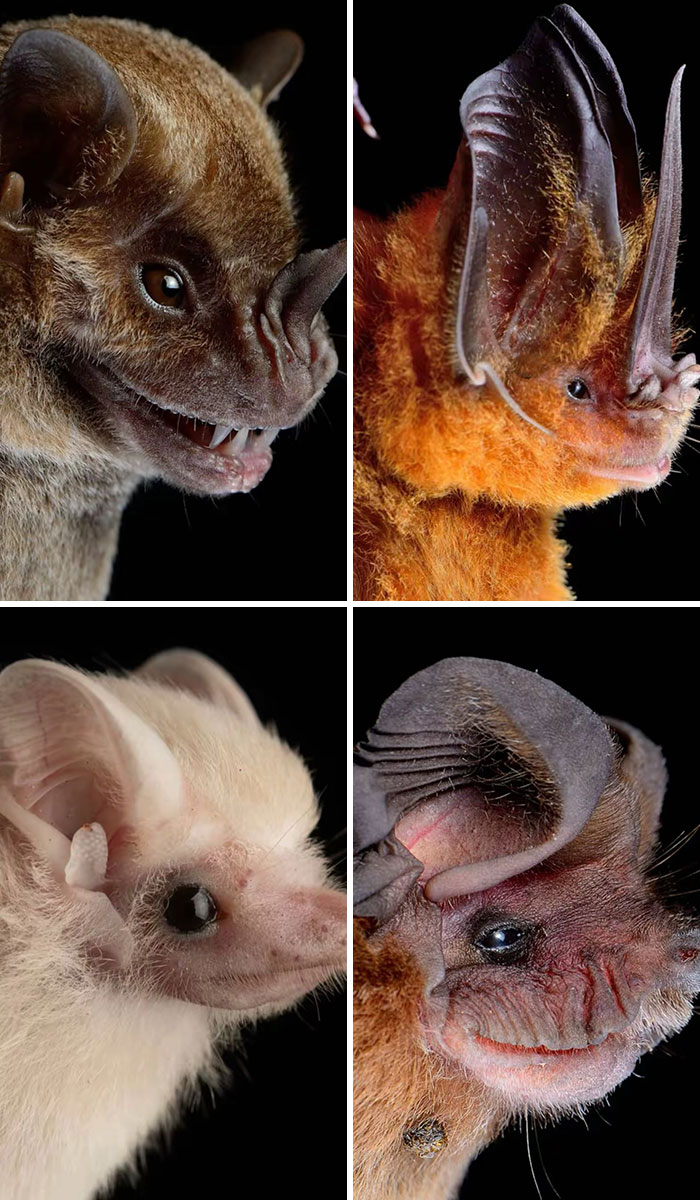
Image source: therealnurtle
These portraits are part of a long-term field project by José G. Martínez-Fonseca, who documents bat species up close during active wildlife research.
The bats were photographed using controlled lighting and very short handling times while researchers were already working with them in the field. Each animal was released immediately after being photographed. No studio setups, no captive environments, and no prolonged restraint were involved.
The project focuses on anatomical detail, scale, and variation between species, capturing facial structures, ears, noses, and fur patterns that are rarely seen this clearly. Many of these traits are directly tied to echolocation, feeding habits, and ecological roles.
The result is a scientific visual record that highlights the diversity of bats rather than portraying them as anonymous silhouettes or myths.
#6
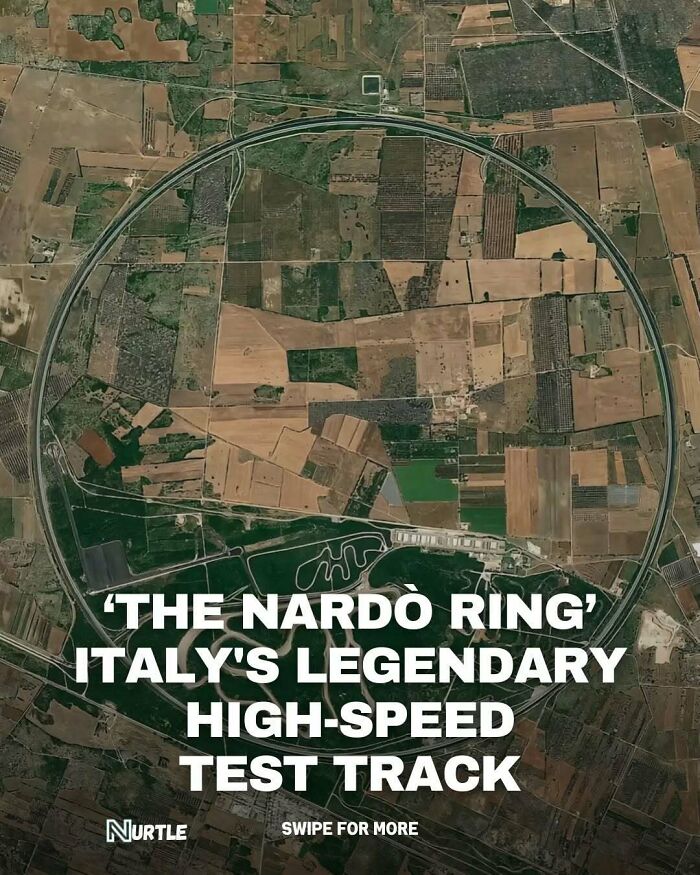
Image source: therealnurtle
Located in southern Italy, the Nardò Ring is one of the most extreme vehicle test tracks ever built. The circular track has a 12.6 km circumference and is engineered so precisely that cars can drive at very high speeds without needing to steer.
Completed in 1975, the ring’s banking and curvature cancel out lateral forces, allowing vehicles to maintain constant throttle while simulating endless straight-line driving. This makes it ideal for testing top speed, stability, endurance, and mechanical limits over long distances.
Over the decades, the track has been used by major manufacturers to validate prototypes, push engines to failure, and set durability benchmarks that are impossible to reach on public roads or traditional circuits.
The facility is now part of a larger proving ground, but the high-speed ring remains its most defining feature.
#7

Image source: therealnurtle
Niklas D. Lindblad uploaded a video years ago titled Being Ugly: My Experience. It sat on his channel without much attention until a single comment shifted the entire direction of his life.
Juli Martinsson replied under the video saying she thought he was cute and meant it. They started talking and stayed in touch.
Juli later traveled from Argentina to Sweden so they could meet in person. They filmed parts of the visit for YouTube and continued documenting their relationship as it grew.
The two eventually married in Sweden with family present. Not long after, they shared a pregnancy update and later posted their first baby photos, marking the start of their new family.
A simple YouTube comment led to a relationship, a move across continents, a wedding, and a child.
#8
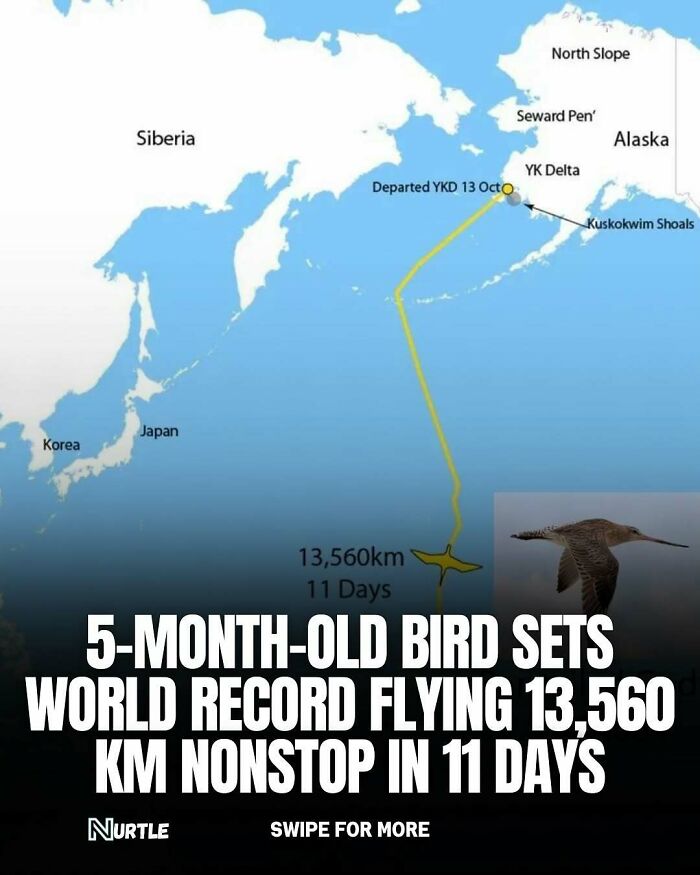
Image source: therealnurtle
A five-month-old bar-tailed godwit set a world record for the longest nonstop bird flight ever recorded.
The bird, tagged as 234684, flew an astonishing 13,560 kilometers from Alaska to Tasmania in 11 days and one hour, without stopping to eat, rest, or land.
Satellite data confirmed it remained in flight the entire time, crossing the Pacific Ocean without pause, not even to sleep.
Scientists believe the bird relied entirely on stored fat and favorable wind patterns to survive the journey. It eventually landed at Ansons Bay in Tasmania, completing the longest continuous migration ever tracked in a bird.
#9
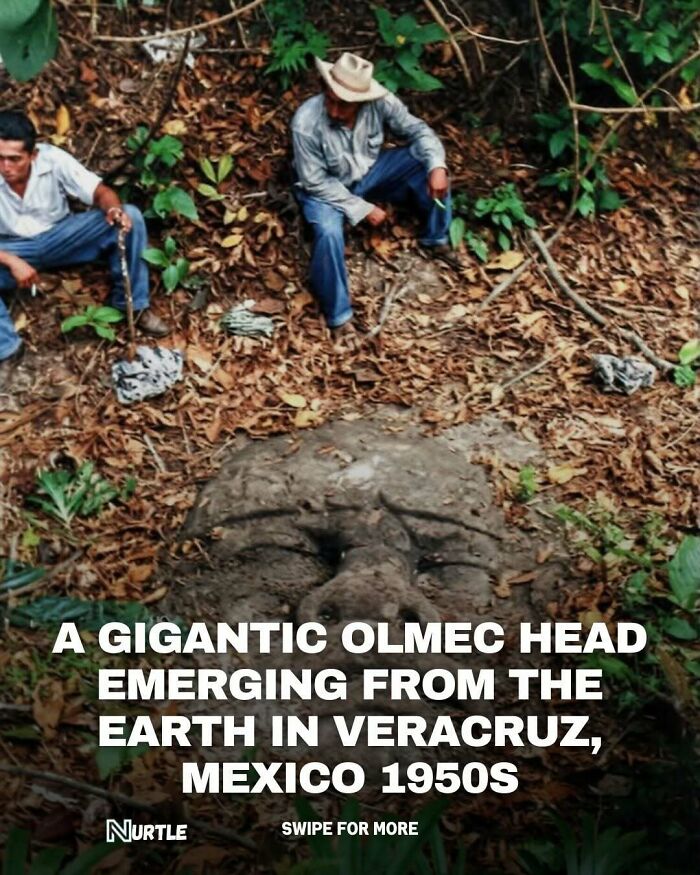
Image source: therealnurtle
In the 1950s, archaeologists in Veracruz, Mexico uncovered massive stone faces buried beneath jungle soil. These were Olmec colossal heads, carved between 1200 and 400 BCE, making them some of the oldest monumental sculptures in the Americas.
Each head was carved from a single block of basalt, with some weighing over 20 tons. The stone was transported from distant volcanic regions without wheels, metal tools, or animals. Every face is unique, suggesting they represent specific Olmec rulers, not gods.
Many heads were found intentionally buried, likely after the ruler they depicted died or lost power.
#10

Image source: therealnurtle
James Cameron has confirmed that no generative AI was used in the production of Avatar: Fire And Ash. The director said the Avatar films do not rely on AI-generated performances and that actors remain central to how the films are made.
“I just wanted to point out we don’t use it on the ‘Avatar’ films. We honor and celebrate actors. We don’t replace actors,” Cameron said in an interview. He clarified that while he is not entirely against generative AI as a technology, he has deliberately kept it out of the Avatar franchise.
Cameron added that Hollywood will likely end up regulating itself when it comes to AI, but stressed that storytelling can only move forward if artists and performers remain at the core of the process. For him, the larger concern is not tools used in filmmaking, but the broader impact of large-scale AI on creative work itself.
Avatar: Fire And Ash continues the franchise’s focus on performance-driven motion capture, with actors physically portraying their characters rather than being digitally generated.
#11

Image source: therealnurtle
This cat was born looking permanently unimpressed.
Thanks to some wild fur markings, this cat appears to have thick eyebrows and a subtle mustache, giving it a face full of expression without ever moving a muscle.
#12

Image source: therealnurtle
The animated film Flow became a global hit after winning the Oscar for Best Animated Feature. The story follows a black cat surviving a massive flood, and its success pushed the film into worldwide attention.
Shelters in several countries reported something unusual after the release. People began asking specifically for black cats, often referencing the movie or calling them “Flow-type cats.” Some centers said they received more adoption requests for black cats than they had seen in years.
Black cats usually face slower adoption rates because of old superstition, which makes the shift noticeable. The trend is not universal everywhere, but the regions reporting changes link the increase directly to the film’s popularity.
#13
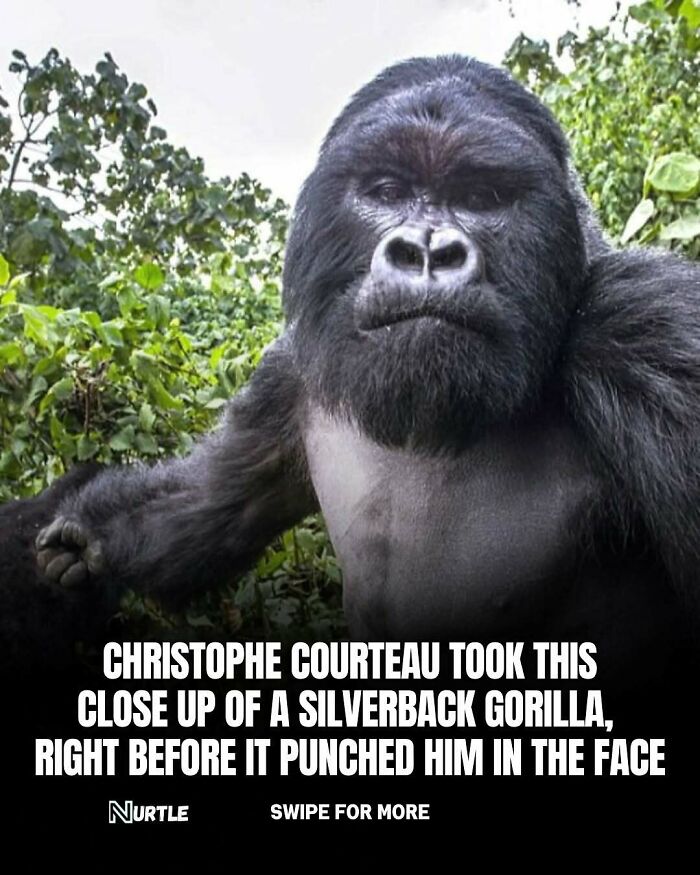
Image source: therealnurtle
A second later, and the lens was full of fist. 😂🦍
Wildlife photographer Christophe Courteau was in the middle of capturing a close-up of a massive 6’6”, 400-pound silverback gorilla in Rwanda when the moment took a sudden turn.
The powerful animal, seemingly agitated by the crowd of tourists nearby, charged straight toward Courteau and landed a direct hit to his face. The photo he snapped just before impact is now one of the most intense wildlife shots ever taken.
Despite the punch, Courteau suffered only minor injuries and continued documenting wildlife. He later said the gorilla was showing dominance, not aggression, a warning to keep distance, not a full-blown attack.
The photo is now considered legendary not just for its clarity, but for the raw unpredictability of nature it captures.
#14
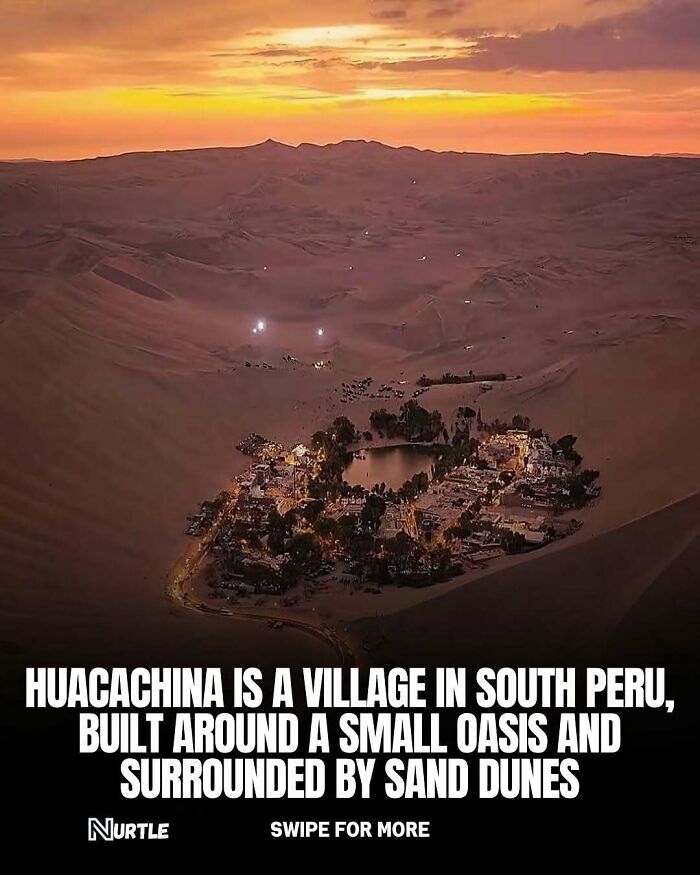
Image source: therealnurtle
Huacachina is a small village in southwestern Peru that looks like something out of a storybook. Built around a natural oasis and surrounded by towering sand dunes, it has a permanent population of only about 100 people.
Despite its tiny size, Huacachina attracts tens of thousands of visitors every year. Tourists come for its unique desert landscape, dune buggies, and sandboarding, making it one of Peru’s most unusual destinations.
At night, the oasis glows with restaurants, hotels, and bars, creating a striking contrast with the vast desert around it.
#15
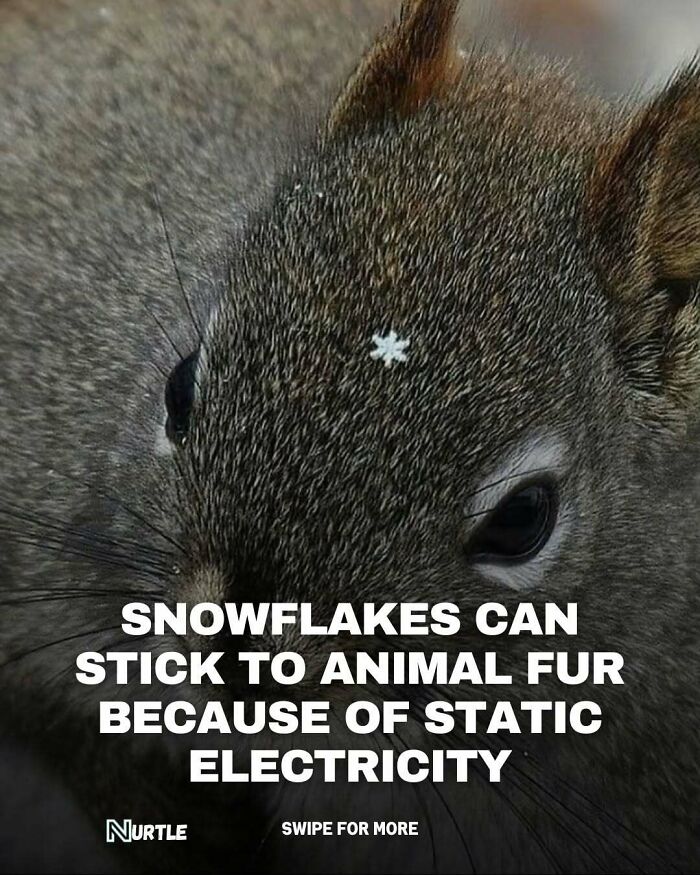
Image source: therealnurtle
In cold, dry conditions, animal fur can build up static electricity.
That static charge attracts lightweight snowflakes and helps them cling to the fur instead of falling off.
Fur also traps air and insulates body heat, so the outer surface stays cold. Because less heat reaches the snowflake, it does not melt immediately and remains visible on the fur.
#16

Image source: therealnurtle
In 1889, Nintendo began in Kyoto as a small workshop, not a tech company. The business was originally called Nintendo Koppai and focused entirely on producing handmade hanafuda playing cards.
The company was founded by Fusajiro Yamauchi, who supplied traditional card decks to local players at a time when most Western-style cards were restricted in Japan. The workshop doubled as both a production space and storefront.
This modest building marked the starting point of a company that would later pivot through toys, electronics, and eventually video games, becoming one of the most influential entertainment companies in the world.
#17
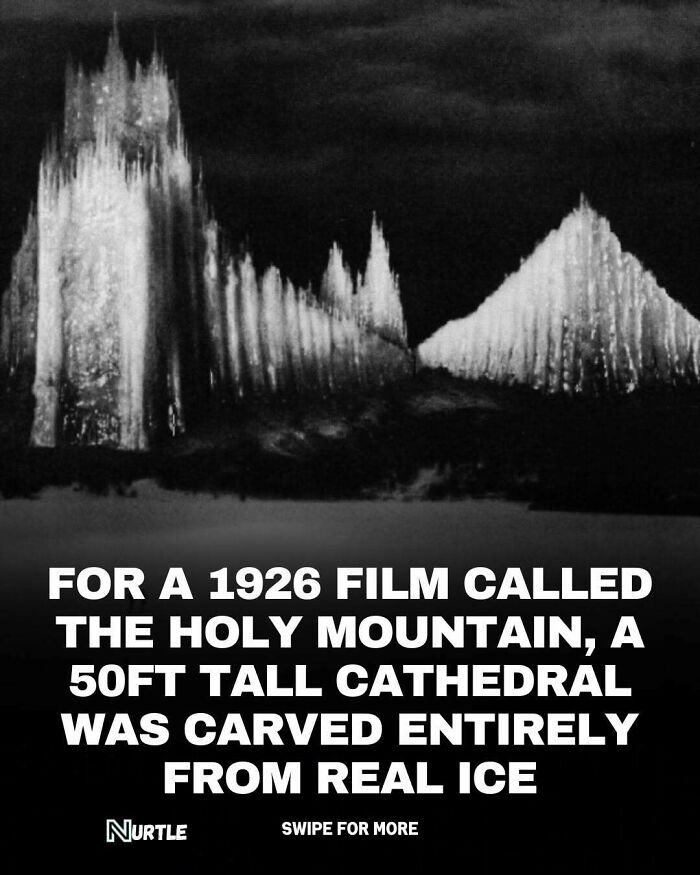
Image source: therealnurtle
For the 1926 silent film The Holy Mountain, director Arnold Fanck ordered the construction of a full-scale cathedral carved entirely from real ice. The structure stood around 50 feet tall and was built in the Alps specifically for the production.
The cathedral was shaped over several months, using blocks of ice carved and stacked around a hidden metal framework to keep it standing. Once filming ended and temperatures changed, the structure was left to melt and collapse naturally.
At the time, large-scale artificial sets were common, but building one entirely from ice was extreme even by 1920s standards. No replicas were made, and nothing survives today beyond the footage captured on film and a handful of production photographs.
#18

Image source: therealnurtle
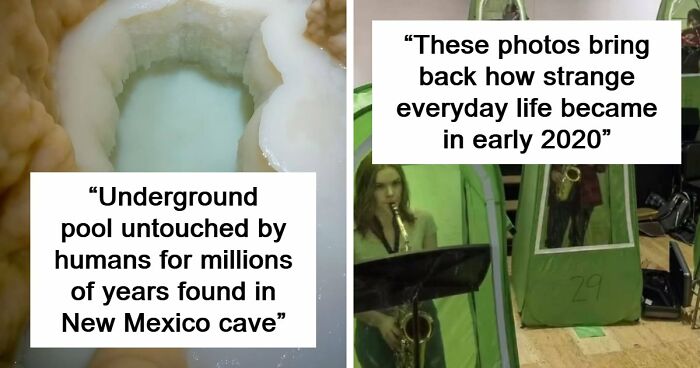
Deep inside Lechuguilla Cave in New Mexico, explorers found an underground pool that had likely been sealed off for millions of years. The discovery was made 700 feet below the surface, in one of the world’s most pristine limestone cave systems.
The water in the pool had never been in contact with humans, making it an incredibly rare find. Scientists believe studying this isolated environment could reveal clues about underground ecosystems and even guide the search for life in extreme places like Mars.
#19
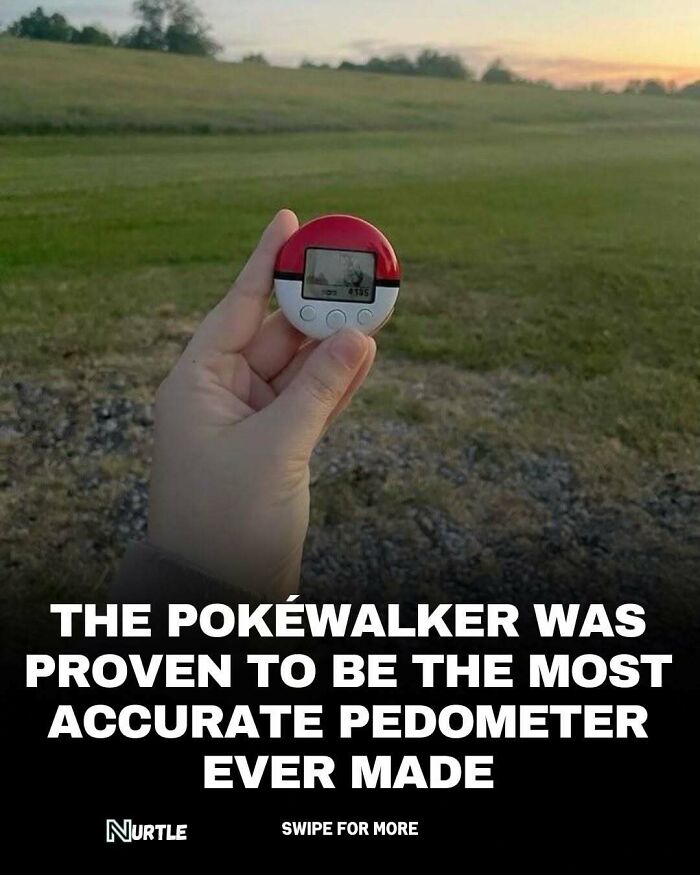
Image source: therealnurtle
The Pokéwalker was released in 2009 as a physical accessory bundled with Pokémon HeartGold and SoulSilver for the Nintendo DS. Shaped like a Poké Ball, the device functioned as a pedometer that let players transfer a Pokémon from their game and level it up by walking in the real world.
Every step counted toward experience points, item unlocks, and in game encounters, turning daily movement into actual progress inside the game. Players could also find items and Pokémon depending on distance walked, making physical activity part of core gameplay rather than a side feature.
In 2011, a study by Iowa State University found that the Pokéwalker was the most accurate consumer pedometer, with lower step counting error than many dedicated fitness trackers on the market.
Years before fitness wearables became mainstream, Nintendo had already turned walking into a game mechanic.
#20

Image source: therealnurtle
These photos bring back how strange everyday life became in early 2020. For a while, scenes like this were normal everywhere. People improvised protection, stores changed their layouts, and routines shifted almost overnight.
What felt intense at the time now feels distant. Cities were empty, travel stopped, and the whole world moved into the same pattern at the same moment. Looking at images like these shows how quickly everything changed and how fast we moved on from something that shaped daily life for so long.
#21
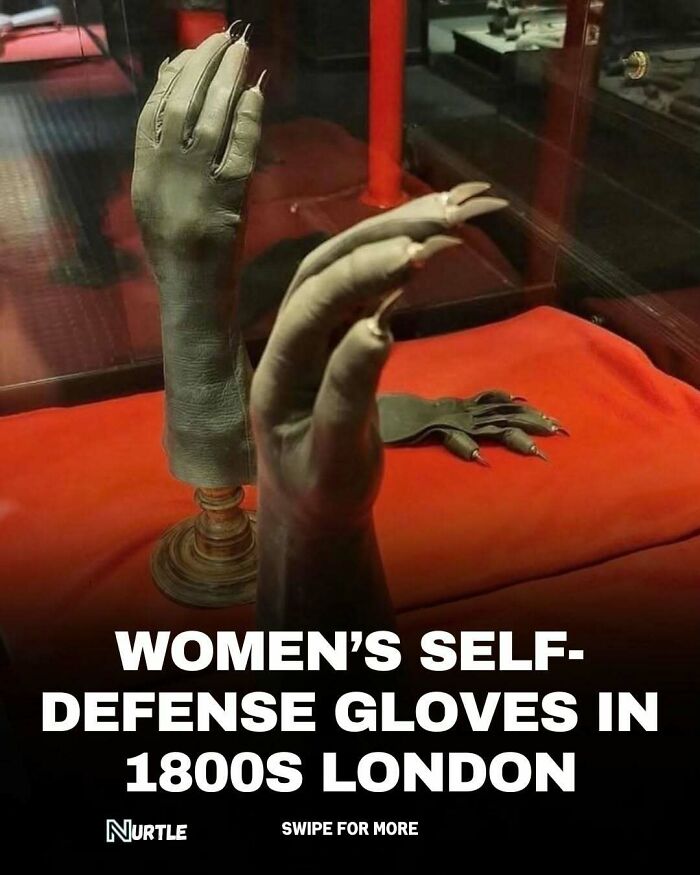
Image source: therealnurtle
In the late 1800s, some self-defense gloves were made in London and other European cities with small metal spikes or sharpened studs sewn into the fingers and knuckles.
They were intended for close physical contact. If someone grabbed a woman’s arm, wrist, or clothing, striking back could cause immediate pain or injury to the attacker’s hands or face, allowing her to pull away. The gloves required no training and could be worn openly as part of normal clothing.
This period was marked by overcrowded streets, poor lighting, and limited police presence at night. Assaults and robberies were common, especially in working-class districts. Other everyday objects were adapted for personal protection at the time, including long hat pins, reinforced parasols, and small blades hidden in clothing.
#22
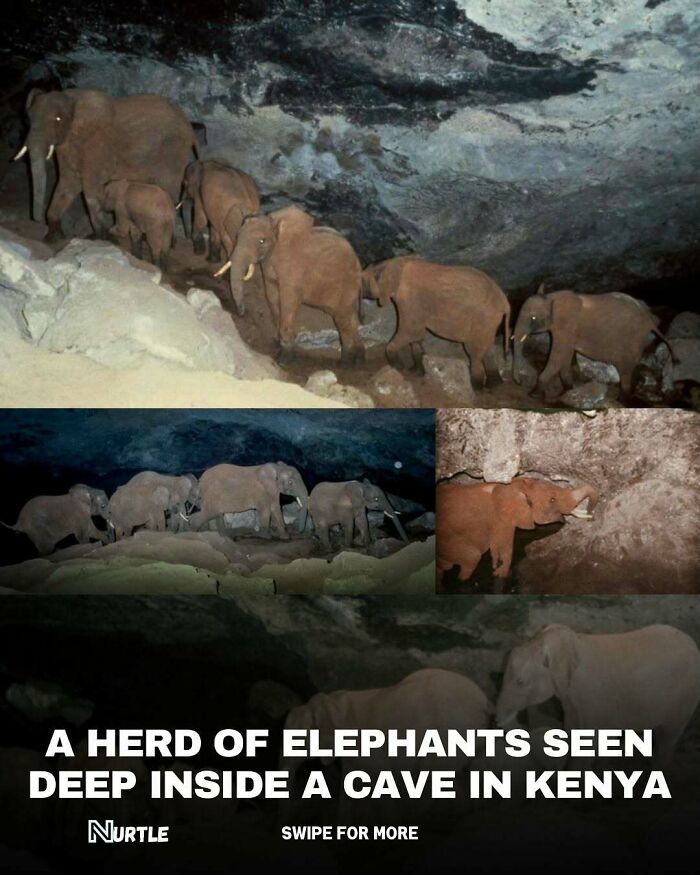
Image source: therealnurtle
Deep inside Mount Elgon in Kenya, elephants walk into pitch-black caves to mine salt. They travel more than 150 meters into the mountain, using their tusks to scrape mineral-rich rock from the walls.
They crush the fragments with their trunks and eat the dust to get sodium and other nutrients missing from their diet. A single elephant can pull out up to 20 kilos of rock in one night, gradually reshaping the caves over centuries.
Calves follow the older elephants, learning how to mine in the dark. What looks like survival is also tradition, passed down through generations.
But the herds are in danger. Uganda’s cave elephants were wiped out in the 1970s, and today only the Kenyan side of Mount Elgon still has them. Conservation groups are fighting to protect these rare miners before they disappear completely.
#23
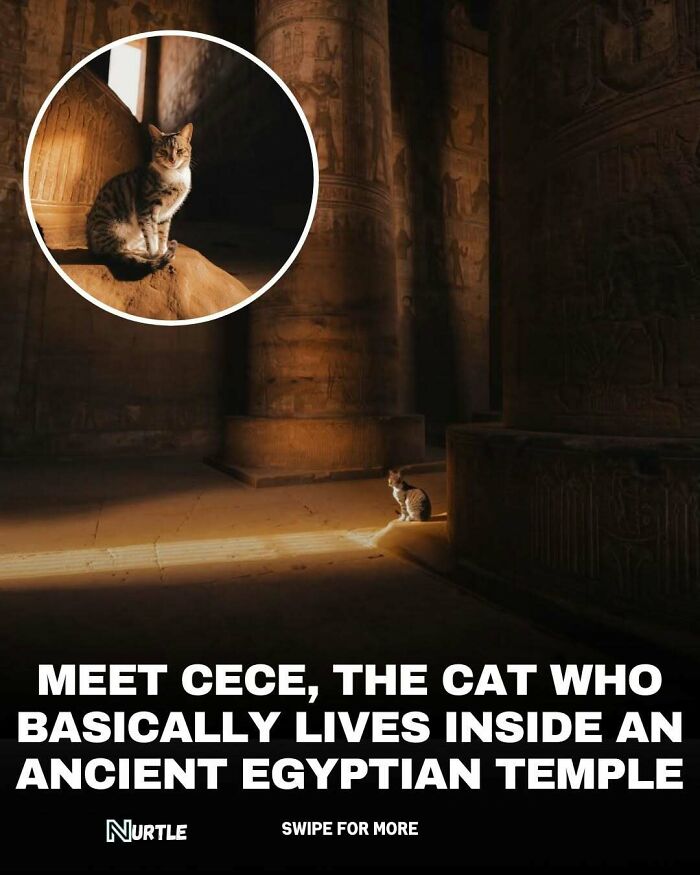
Image source: therealnurtle
At the Temple of Dendera in Luxor, a local cat named Cece has become a familiar sight for visitors. She spends her days moving through the ancient halls, appearing around columns and courtyards while tourists explore the site. Guides and staff say she has been around long enough that many visitors look for her when they arrive.
Cece usually stays close to shaded areas inside the temple and often sits near the walls where the stone stays cool. Cats living around archaeological sites in Egypt aren’t unusual, but Cece is one of the few that regularly appears in photos taken by tourists.
She isn’t an official guardian of the temple, but her presence has turned her into a small part of the visitor experience at Dendera.
#24

Image source: therealnurtle
In 1960, Tokyo looked nothing like the city people picture today. The skyline was still low and spread out, dominated by wooden houses, tiled roofs, and tightly packed neighborhoods rather than glass towers.
Even Tokyo Tower, completed just two years earlier, stood out dramatically because almost nothing around it rose higher than a few stories. At the time, strict height limits and building regulations kept construction low, partly due to earthquake concerns and postwar rebuilding priorities.
Most of the city was still recovering from World War II. Entire districts had been destroyed, and reconstruction focused on housing and infrastructure rather than vertical expansion. Streets were narrow, communities were dense, and daily life revolved around walkable neighborhoods.
That began to change in the early 1960s as Japan entered a period of rapid economic growth. The 1964 Tokyo Olympics became a turning point, pushing modernization, new transport systems, and eventually the removal of height restrictions.
What followed over the next decades was one of the fastest urban transformations in modern history, turning Tokyo from a low rise city into one of the most vertical megacities on Earth.
#25
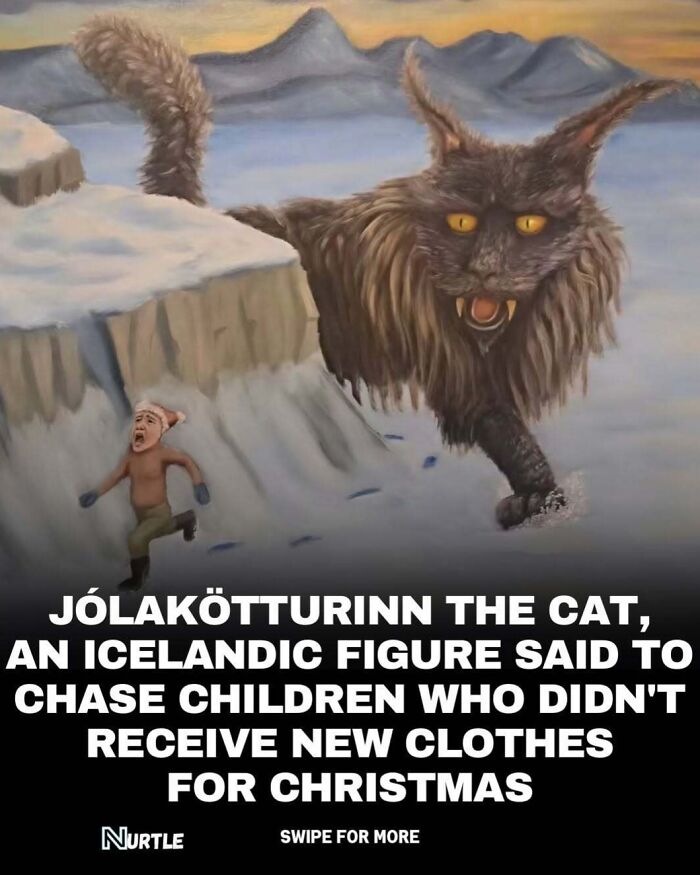
Image source: therealnurtle
Jólakötturinn, known as the Yule Cat, is a figure from Icelandic folklore said to eat children who did not receive new clothes for Christmas. The story dates back to at least the 19th century and is closely tied to Iceland’s historical wool industry.
In rural Iceland, families relied heavily on wool production to survive harsh winters. Everyone, including children, was expected to help process wool before winter arrived. Those who completed their work were rewarded with new clothing made from the finished wool.
The Yule Cat legend acted as a warning. Children who failed to do their share of the labor were said to be at risk of being eaten by the cat, while those who worked hard were safe and received new garments. The story reinforced productivity and discipline during the darkest months of the year.
Today, the Yule Cat remains a well-known part of Icelandic Christmas folklore, often referenced in stories, decorations, and poems, though it’s now treated as cultural tradition rather than a literal threat.
#26
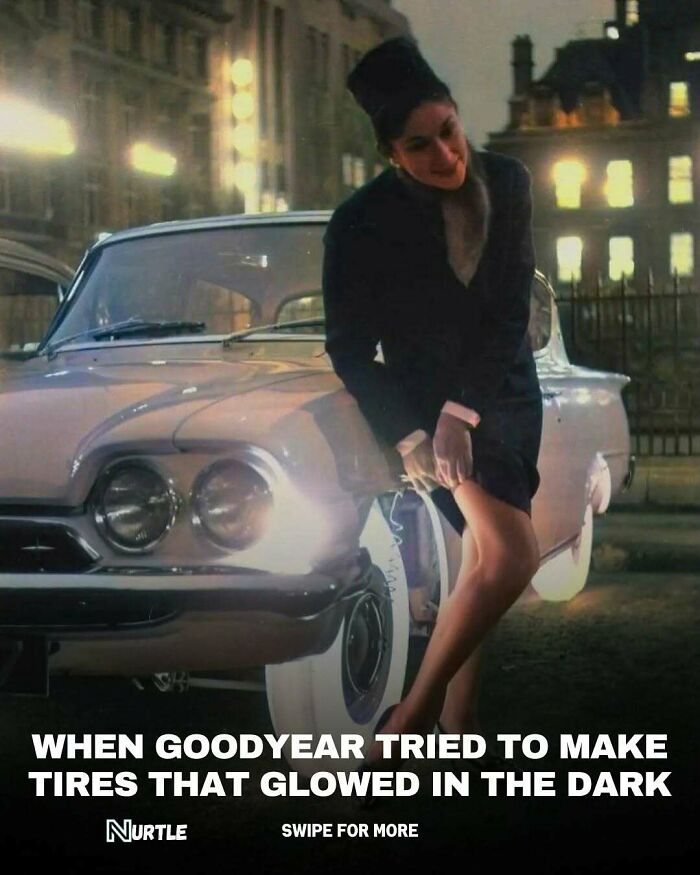
Image source: therealnurtle
In the 1960s, Goodyear engineers began testing something straight out of science fiction, glowing tires. Made from a synthetic rubber called Neotan, the translucent material was heated and molded to produce a soft glow whenever the car moved.
Each tire contained small lights inside the rim that could flash or stay lit, creating a futuristic effect that turned heads at car shows and night parades. The company hoped it would revolutionize the look of cars, blending performance with style.
But the idea never made it past the prototype stage. The material proved too fragile and expensive for real-world use, leaving only photos and a few surviving test models as proof that glowing tires once existed.
#27
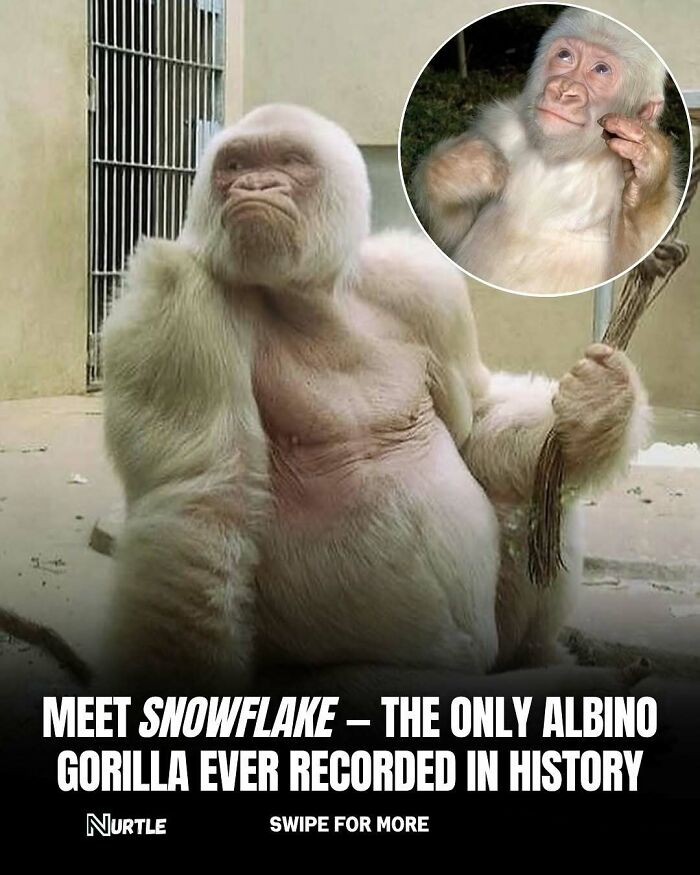
Image source: therealnurtle
Snowflake was the world’s only known albino gorilla. Discovered in 1966 in Equatorial Guinea, he was captured by local farmers and eventually brought to the Barcelona Zoo, where he lived for nearly 40 years.
What made Snowflake so unique was his complete lack of pigmentation, giving him white fur and pinkish skin — a condition extremely rare in gorillas. Genetic studies later revealed that his albinism was caused by inbreeding, which made his case even more unusual in the wild.
Despite his condition, Snowflake lived a long life under careful care. Visitors from all over the world came to see him, making him one of the most famous animals in captivity. He passed away in 2003, but remains the only albino gorilla ever recorded.
#28

Image source: therealnurtle
Giant pandas are officially no longer listed as endangered. The species is now classified as vulnerable after a sustained increase in its wild population.
This shift reflects decades of conservation efforts in China, including strict habitat protection, the expansion of panda reserves, and coordinated breeding programs. Together, these measures helped stabilize and grow the population, which now exceeds 1,800 pandas living in the wild.
Pandas were previously pushed to the brink by deforestation, agricultural expansion, and fragmented bamboo forests. Because their diet depends almost entirely on bamboo, even limited habitat loss had a direct impact on survival.
Being listed as vulnerable does not mean pandas are out of danger. Their habitat remains fragmented, and climate change continues to threaten bamboo growth across large parts of their range, making continued protection essential.
#29
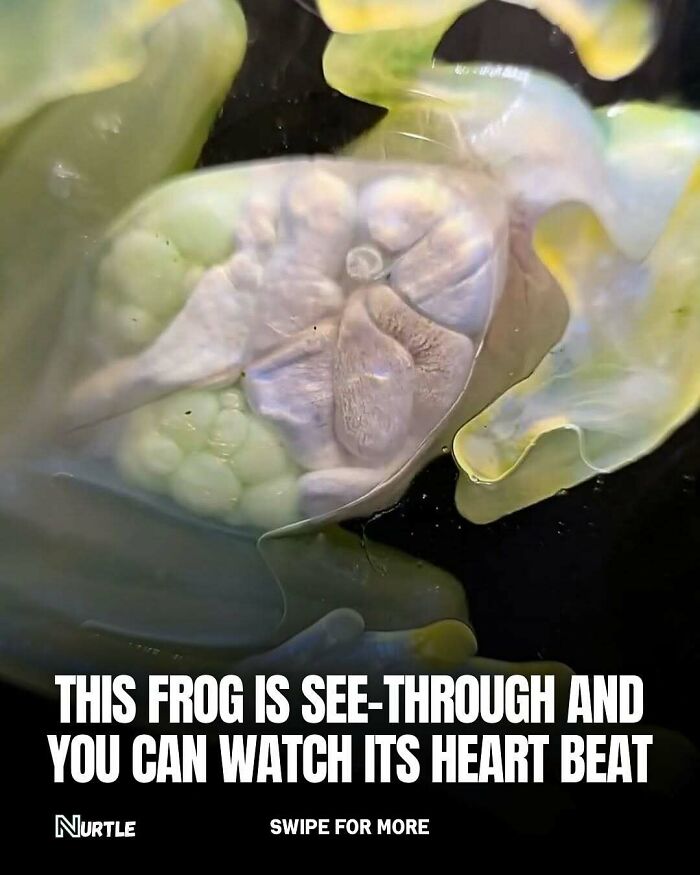
Image source: therealnurtle
Located in Central and South America, the glass frog is one of nature’s strangest survival designs. Its skin is so clear that you can literally see its heart beating inside, along with its organs.
This transparency is more than just unusual—it’s a powerful defense mechanism. By letting light pass through its body, the frog avoids casting a shadow, blending almost seamlessly with the green leaves it rests on. Predators looking for movement or shapes often miss it entirely.
Scientists discovered that when glass frogs sleep, they push most of their red blood cells into their liver. This reduces the visible color in their bodies, making them nearly invisible while resting. When they wake up, the red blood cells return to circulation.
#30

Image source: therealnurtle
LEGO once rewarded employee loyalty with actual gold.
Between 1979 and 1981, the company gifted 2×4 LEGO bricks made of solid 14-karat gold to workers who hit their 25-year milestone. Each gold brick weighed about 25 grams and could click onto standard LEGO pieces just like the plastic ones.
But this wasn’t a global tradition. It only happened at LEGO’s Hohenwestedt factory in Germany, and fewer than 100 of these bricks are believed to exist.
Today, they’re among the rarest LEGO items in the world, with auction prices soaring above $15,000.
#31
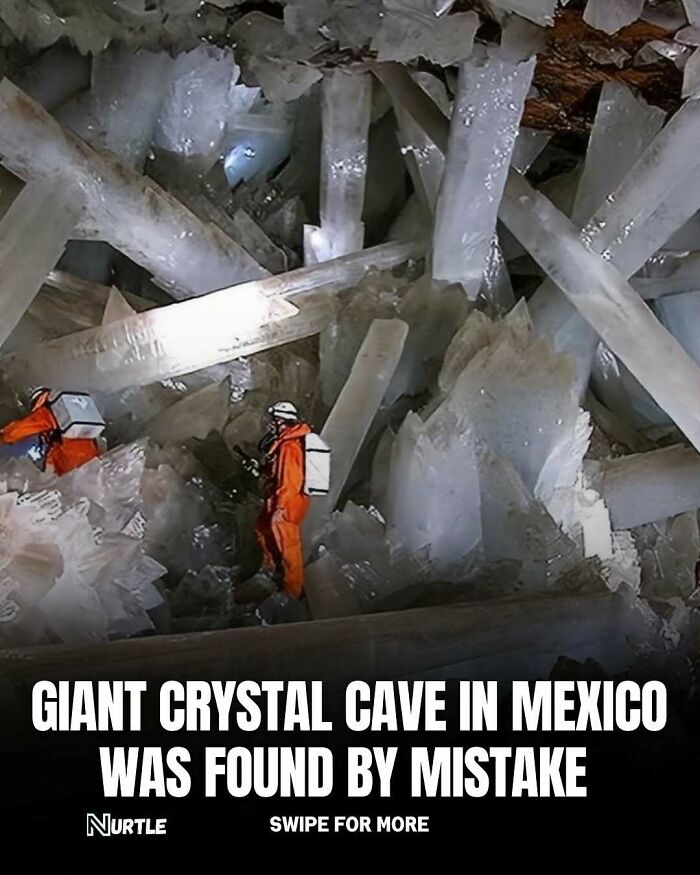
Image source: therealnurtle
Deep beneath the surface of Chihuahua, Mexico, lies one of the most surreal places on Earth: the Giant Crystal Cave.
Discovered completely by accident in 2000, this underground marvel was found when two brothers were drilling into the Naica Mine in search of silver. What they uncovered instead was something no one expected — a hidden chamber filled with enormous selenite crystals, some stretching up to 11 meters (36 feet) long.
The cave had been sealed off from the outside world for hundreds of thousands of years, allowing the crystals to grow to massive sizes in the hot, mineral-rich environment. But stepping inside isn’t easy — with temperatures reaching 58°C (136°F) and nearly 100% humidity, scientists can only explore it for minutes at a time using protective gear and oxygen tanks.
Since its discovery, the cave has attracted geologists and researchers from around the globe, all eager to study how such extreme conditions gave rise to one of Earth’s most unique natural formations.
#32

Image source: therealnurtle
In 2000, Xue posed for a photo at May Fourth Square in Qingdao, China. She had no idea that the man casually walking in the background, Ye, would one day become her husband.
More than a decade later, in 2011, the two officially met in Chengdu. They fell in love, married soon after, and only later discovered the old photo. The image revealed they had unknowingly crossed paths 11 years earlier, captured in the same frame without realizing it.
For the couple, the photo became a symbol of fate, a reminder that sometimes life brings people together long before they even notice.
#33
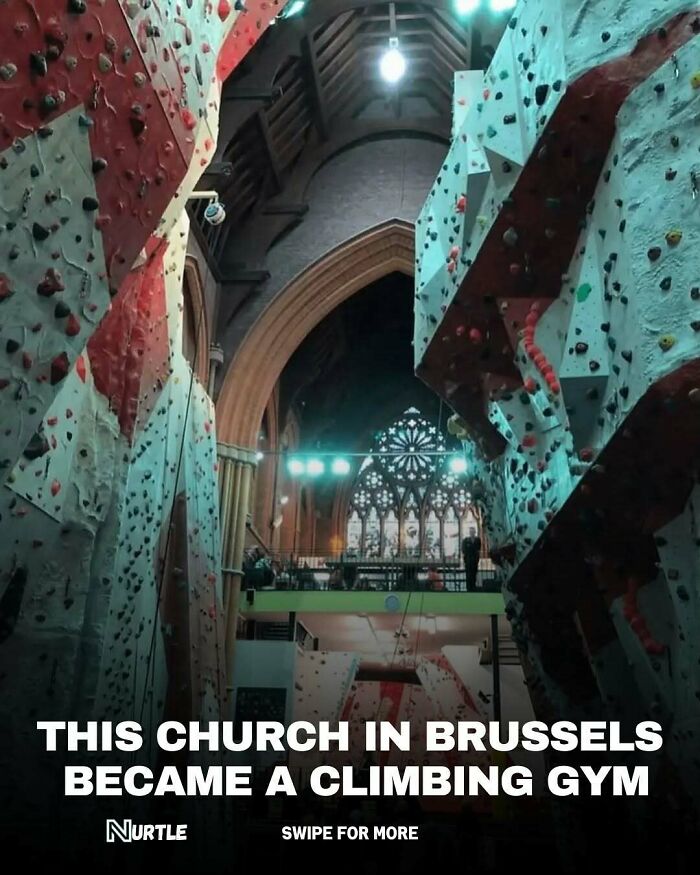
Image source: therealnurtle
A historic church in Brussels has been transformed into a climbing gym after years of declining attendance and high maintenance costs. The Saint Anthony of Padua Church was repurposed to preserve the building while giving it a new purpose for the local community.
Today, climbers scale walls that stretch up toward the original vaulted ceilings, blending modern sport with historic architecture. The gym, called Maniak Padoue, has become a unique spot where history and recreation meet.
#34
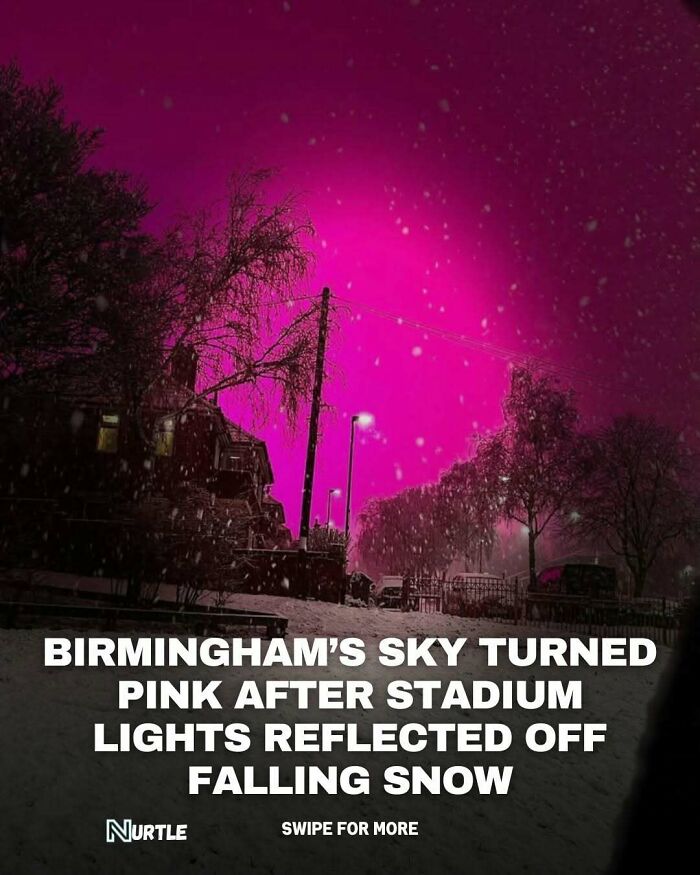
Image source: therealnurtle
The city of Birmingham in England experienced an unusual pink glow across the night sky during snowfall, caused by powerful LED stadium lighting reflecting off low clouds and falling snow.
The light source was traced to Birmingham City FC’s stadium, St Andrew’s, where high-intensity LED floodlights were in use. Modern LEDs emit a broader and more saturated color spectrum than older sodium lamps, making atmospheric reflections far more vivid.
When snow falls, each snowflake acts like a tiny reflective surface. Combined with low cloud cover, the light becomes trapped and scattered, creating a large-scale glow visible across wide parts of Birmingham. The effect is strongest during snowfall or heavy mist, when light cannot escape upward.
Similar phenomena have been observed near greenhouses using grow lights and at sports venues worldwide, but it remains rare in dense urban areas at this scale.
#35

Image source: therealnurtle
Some cats are born with extra toes, a genetic condition known as polydactyly. While most cats have 18 toes, polydactyl cats can have 20 or more, usually on their front paws, giving them a wide or mitten-like appearance.
The condition is caused by a dominant genetic mutation, meaning it can be passed down from just one parent. In most cases, it does not affect a cat’s health, movement, or lifespan. Many polydactyl cats live completely normal lives without any medical issues related to the extra toes.
Polydactyl cats are especially common in coastal areas of the US, Canada, and the UK. Sailors often kept them on ships, believing their larger paws helped with balance and made them better hunters, which helped spread the trait through port towns.
#36
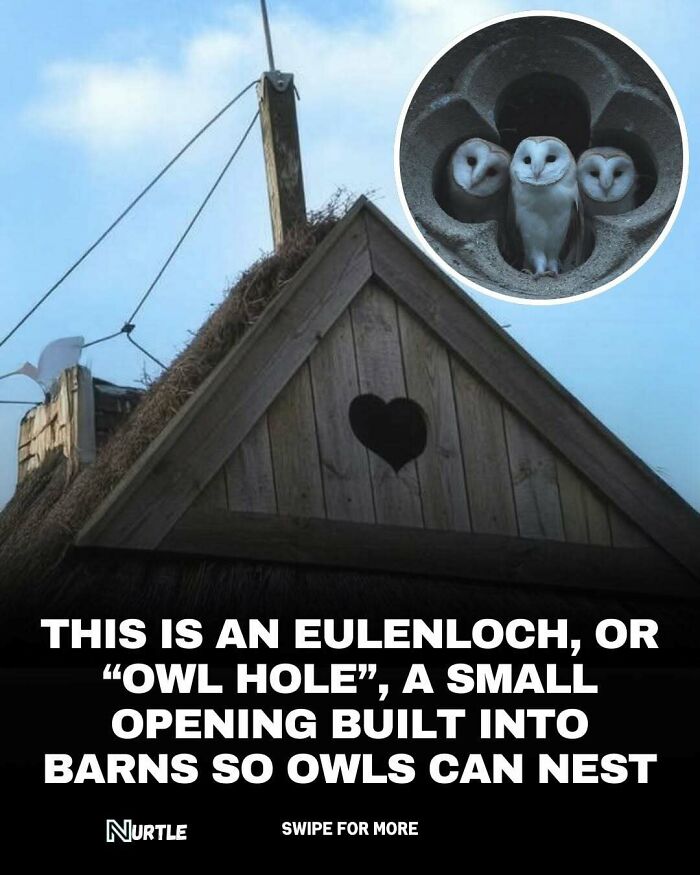
Image source: therealnurtle
An Eulenloch, literally meaning “owl hole,” is a small opening traditionally built into the upper walls of rural barns across parts of Central Europe. Its purpose was to allow owls to enter barns and nest inside.
Farmers used Eulenlöcher as a natural form of pest control. Owls hunting from inside barns helped reduce populations of mice and rats that threatened stored grain, hay, and wooden structures. The holes were usually placed high up to keep predators out and give owls a safe nesting spot.
These openings were not decorative. Their size, placement, and shape were carefully chosen so owls could pass through while limiting access for larger animals. In many regions, barn owls became closely tied to farm life because of this architectural feature.
As modern farming methods changed and barns were sealed or demolished, Eulenlöcher became far less common. Conservation groups now sometimes reintroduce owl openings or nest boxes to help declining barn owl populations return to agricultural areas.
#37

Image source: therealnurtle
The Valais Blacknose sheep might be the most stylish animals on the planet. With their shaggy white wool, dark spiral horns, and perfectly black faces, they’ve earned a reputation as the “coolest-looking” sheep breed in existence.
But it’s not just their looks that make them stand out. These sheep are surprisingly dog-like; friendly, loyal, and incredibly social. Originally from the Valais region in Switzerland, they’ve become known for how much they love human interaction. Some owners even train them to follow commands, go on walks, or come when called.
Despite their punk-rock appearance, they’re calm, affectionate, and thrive on companionship. Whether they’re living on a farm or showing up at festivals, Valais Blacknose sheep are winning hearts everywhere they go.
#38
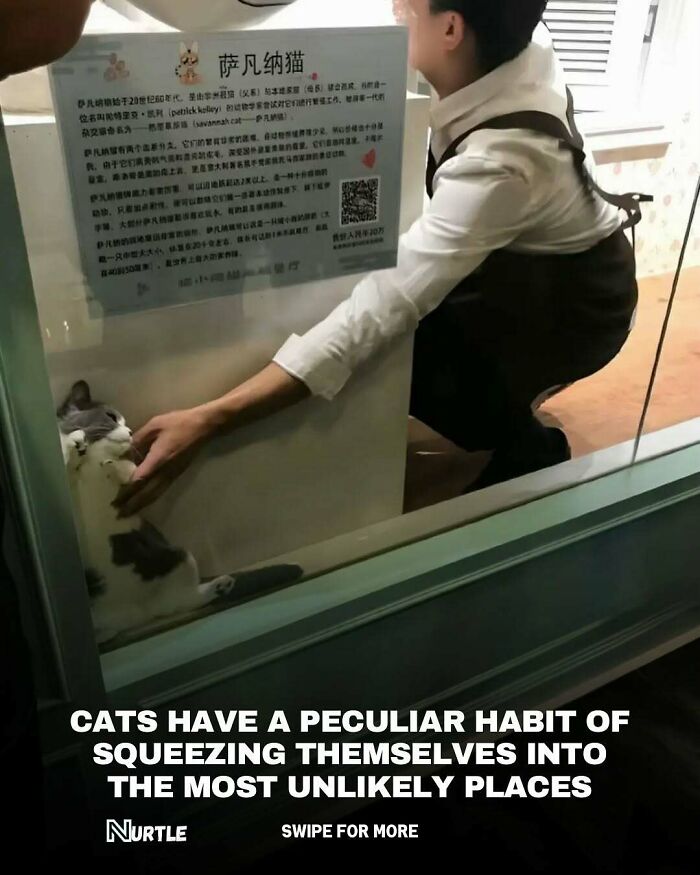
Image source: therealnurtle
Cats are known for slipping into boxes, drawers, and the tiniest gaps they can find. It’s not random behavior but rooted in instinct.
In the wild, tight spaces protect cats from predators and help them stay warm by conserving body heat. The enclosed feeling gives them comfort and control over their surroundings.
So when a cat curls up in a cramped spot, it’s not just being silly, it’s acting on a survival instinct.
#39

Image source: therealnurtle
In a remote village in Yunnan, a young student named Wang Fuman became known across China after arriving at school with his hair and eyebrows covered in frost. He had walked several kilometers through freezing temperatures to make it in time for an important exam, a routine that was normal for him and many other children in the region.
His school sits in one of Yunnan’s mountainous areas where winters are harsh and heating at home is limited. The long daily walk exposes students to cold winds and rough terrain, but education remains a priority for families who often live far from the nearest classroom.
The pictures of Wang’s frozen hair drew attention to the difficulties students face in rural parts of China. Local authorities later improved insulation at the school and provided basic support for children who travel long distances in cold weather.
#40
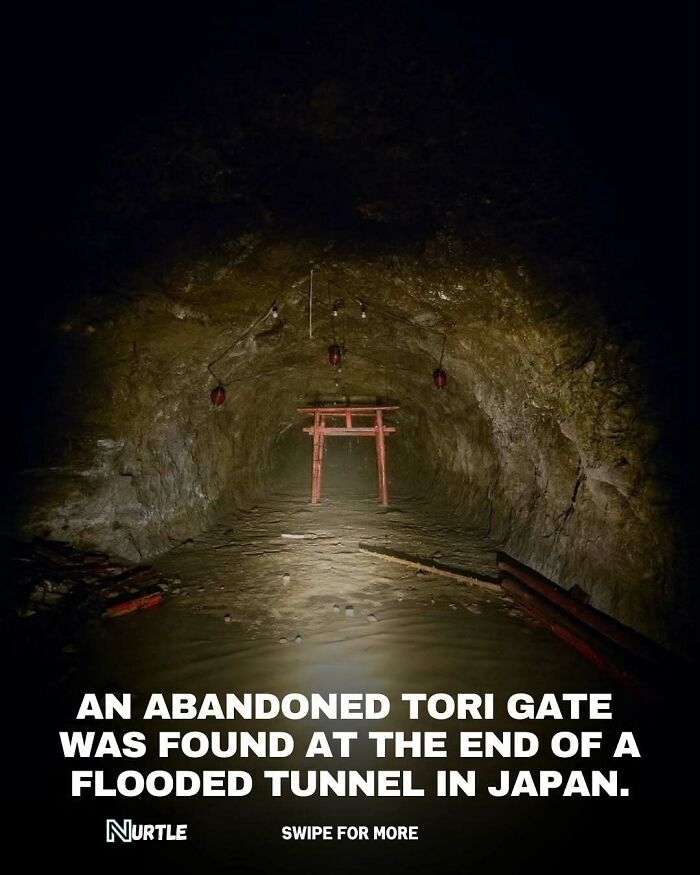
Image source: therealnurtle
Deep inside a flooded tunnel in Kani City, Japan, stands a single Torii gate that once marked the entrance to the Amagamine Ochobo Inari Shrine. What’s now an eerie underground site used to be part of a festival space, abandoned after severe flooding made it inaccessible.
Torii gates in Shinto mark the border between everyday life and sacred spaces, symbolizing a passage into the realm of the gods. This one, hidden in a dark water-filled tunnel, carries a surreal and almost unsettling energy.
Over time, it became a mysterious spot for explorers and photographers who document forgotten places across Japan.



Got wisdom to pour?